
Published 19 November 2026
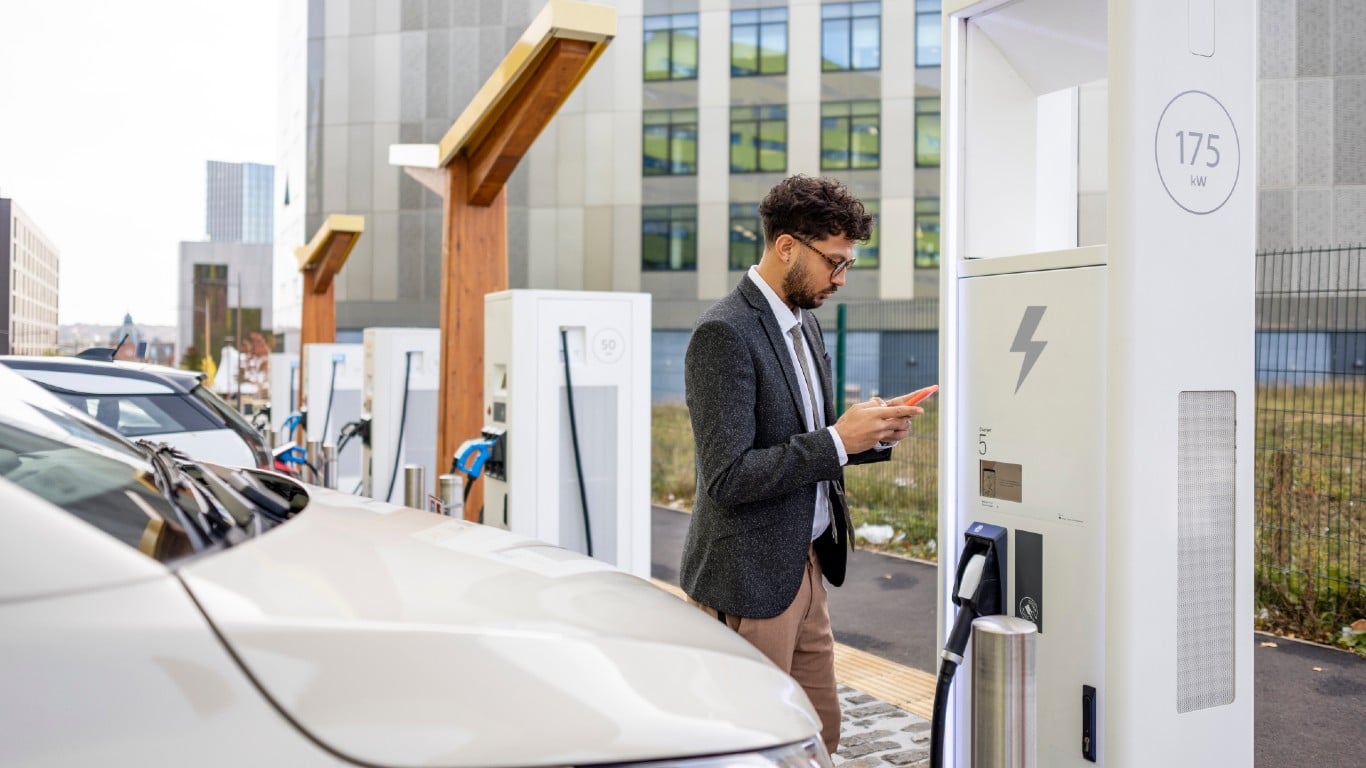
EV charging points for a UK road trip
Key Takeaways:
- Allianz have located the best charging points on UK motorways, so you can plan your longer drives.
- Allianz know what makes a great charging station, and how to pay without getting caught out.
Whether you're asking "where's the nearest EV charger?" on a daily commute or planning a longer road trip, finding a reliable and convenient charging point matters.
Unlike petrol or diesel, you can't just rely on the next services having a compatible, working, or free charger when your battery runs low. A bit of planning, and knowing where to search, turns a potentially stressful trip into a smooth one.
Finding EV charging points near you
Before you even hit the motorway, it helps to know how to find a charger wherever you are, whether that's on-street in London, in a Manchester car park, or in a rural village.
Apps and websites such as Zapmap let you search by postcode, town or region and see, in real time:
- Which chargers nearby are free, in use or out of service.
- The connector type and power output available at each location.
- The cost per kWh before you plug in.
For daily, local charging, filtering by "fast" or "on-street" chargers is usually enough. For a long journey, switch the filter to "rapid" or "ultra-rapid" and plan your stops in advance, which is exactly what the rest of this guide covers.
Motorway charging networks and costs
Motorway charging typically ranges from 40p to 60p per kWh at the cheaper end, or up to 75p to 89p per kWh for premium ultra-rapid networks. For ease of use, look for the newer "Electric Super Hubs", as these feature contactless tap-and-pay and large banks of 150kW to 350kW chargers, so you shouldn't have to queue.
Top EV charging stations by region
Some service stations stand out for their speed, reliability or value. Here's a quick comparison of the best stops around the country.
Swipe to view more
| Motorway | Service station | Highlights |
| M25 | South Mimms (J23) | 64 DC rapid bays, Applegreen and Tesla, 11 food outlets |
| M25 | Cobham (J9-10) | 50 connectors, IONITY, GRIDSERVE and Tesla |
| M1 | Woolley Edge |
22 ultra-rapid chargers, mainly GRIDSERVE |
| M4 | Reading Services |
Large GRIDSERVE and Tesla bank, cheaper option at Junction 12 |
| A1(M) | Scotch Corner | One of the UK's cheapest motorway charging stops |
| A1(M)/M6 | Rugby Services | Rated the UK's number one EV service station, 24 ultra-rapid chargers |
| M5 |
Exeter Services |
28 chargers including 12 ultra-rapid and 16 Tesla Superchargers |
| M60 | Trafford Centre | Large Tesla Supercharger hub, off-peak rates |
| M8 |
Heart of Scotland (Harthill) |
Reliable GRIDSERVE ultra-rapid charging midway between Glasgow and Edinburgh |
Public EV charging: top tips for motorways
- Watch your parking limit: Most service areas allow two hours of free parking while you charge up. Overstaying can trigger an automatic number plate recognition fine.
- Use a roaming app: Apps such as Zapmap allow you to pay across different networks without downloading a load of separate apps.
- Plan your plug-ins: When planning your route, make sure you factor in where you’ll stop to recharge.
What makes a good EV charging station?
A good charging stop is about more than just a plug. The best ones combine speed, reliability and comfort so your charge finishes before you've even settled in.
High-power chargers (100kW to 350kW) and reliability
Chargers generally fall into three speed tiers:
- Low (3kW to 6kW), typically at home or a lamp-post charger, taking 6 to 12 hours for a full charge.
- Fast (7kW to 22kW), common at workplaces and supermarkets, taking 3 to 4 hours for a full charge
- Rapid or ultra-rapid (50kW to 350kW), built for quick top-ups on the road.
So, on a road trip, you’ll want to look for ultra-rapid DC chargers with a high power output. A 350kW charger can add 100 to 200 miles of range in just 15 to 20 minutes… just enough time to grab a coffee! Top-tier hubs also use dynamic power sharing, automatically redirecting spare electricity to your car when a neighbouring bay finishes charging.
The more the merrier: A great stop offers 12 to 30+ charging bays, meaning you're unlikely to queue, and if one or two units are out of action, it won't ruin your journey.
Convenience is key: The best sites also let you simply plug in or tap a contactless card, with no app or membership required.
Area, amenities and accessibility
The best modern hubs feature wide, drive-through bays, which are ideal if you're towing a trailer, caravan, or driving a larger electric van for your long drive. Lit overhead canopies keep you dry and safe at night, while long, well-supported cables mean you don't have to park awkwardly to reach your charging port.
As you'll likely be stationary for 20 to 40 minutes while your car charges, good amenities really matter. Things like clean indoor toilets, a mix of grab-and-go and sit-down food options, and free Wi-Fi if you need to connect, work, or keep the kids entertained.
Connector compatibility
Most modern UK public chargers use a Type 2 connector for slow and fast AC charging, while rapid and ultra-rapid DC chargers typically use a CCS (Combined Charging System) plug, essentially a Type 2 socket with two extra pins underneath.
Older rapid chargers, still found on some Japanese and Korean EVs, use the CHAdeMO standard instead.
Tesla vehicles charge via the Tesla connector at Superchargers, or with a CCS adapter on other networks.
So, checking your car's socket before a trip means you won't arrive at a rapid hub your cable can't actually use.
Service stations with outdoor areas
It’s not just our cars that need re-charging! Drivers, passengers, kids and pets all need a leg stretch on a long drive, so we’ve put together a list of service stations across the UK with outdoor areas for some fresh air and a stretch out! So, plug in and have a wander at some of the UK’s most scenic service stations…
-
Gloucester Services
-
Cobham Services
-
Beaconsfield Services
-
Leeds Skelton Lake Services
-
Tebay Services
-
Annandale Water Services
- Location: Gloucestershire, South West England, located on the M5 between Junctions 11a and 12.
- Outdoor offerings: Landscaped Cotswold lawns, a peaceful duck pond, and a dedicated dog-walking trail.
- Location: Greater London/Surrey border, South East England, located on the M25 between Junctions 9 and 10.
- Outdoor offerings: A large, bustling lakeside terrace with wooden boardwalks and an outdoor children's play area.
- Location: Buckinghamshire, just northwest of London, located on the M40, Junction 2.
- Outdoor offerings: A large central lakeside terrace surrounded by native trees and a gated outdoor adventure playground.
- Location: West Yorkshire, Northern England, located on the M1, Junction 45.
- Outdoor Vibe: A modern paved dining terrace opening up directly onto a playground and nature paths looping around Skelton Lake.
- Location: Cumbria, Northwest England, located on the M6 between Junctions 38 and 39.
- Outdoor offerings: Sweeping views of the Cumbrian fells, a classic duck pond with picnic banks, and large fenced grass fields for dogs.
- Location: Dumfries and Galloway, Southern Scotland located on the A74 (M), Junction 16.
- Outdoor offerings: The northernmost stop on our list, built entirely around the shores of a natural lake with extensive waterside walking paths.
How do you pay for EV charging in the UK?
Tapping a contactless card is the easiest way to pay, but it isn't always the cheapest. Many networks charge a premium for contactless, while using their free smartphone app or a roaming RFID (Radio-Frequency Identification) card, can save you 5p to 10p per kWh.
Contactless readers also place a temporary pre-authorisation hold on your account, sometimes £30 to £40 or more, which drops off later but can catch you off guard if your balance is tight.
Is it better to charge your EV to 80% or 100%?
When charging to 80% makes sense
- Keeping lithium-ion (NMC) batteries below 100% lowers chemical and thermal stress internally.
- An 80% charge leaves room in the battery to absorb energy recovered from braking.
- Charging slows down significantly after hitting 80%, so stopping there saves time at public rapid chargers.
- According to guidelines from providers, capping daily limits helps prevent premature capacity loss.
When charging to 100% makes sense
- A full charge provides maximum range when you need every mile, so it’s worth doing before a long drive.
- Charging to 100% right before you leave is fine; but you shouldn’t let an EV sit parked at 100% for days or weeks.
- LFP (Lithium Iron Phosphate) batteries tolerate full charges differently and often need to be charged to 100% weekly for optimum battery management.
The 10% to 80% rule for long drives
When using rapid or ultra-rapid chargers, aim to arrive low and leave before you hit full.
- Arrive low at 10% to 20%
EVs charge fastest when the battery's empty, so you're back on the road faster.
- Leave when you hit 80%
Going from 80% to 100% can take as long as 10% to 80%, so unplug at 80% and go.
The 20% to 80% rule for daily driving
For your weekly commute or A to B drives, the focus is on battery longevity.
- Avoid extremes
Batteries face the most chemical stress when fully charged or nearly empty.
- The sweet spot
Keeping your battery between 20% and 80% slows degradation over time.
The exception: LFP batteries
Check whether your electric car uses a Lithium Iron Phosphate (LFP) battery, which is standard in cars like the Tesla Model 3/Y, MG4, and most BYD models. These batteries handle high voltages better, so manufacturers recommend charging to 100% weekly.
UK EV charging networks and companies
With so many providers on the road, it helps to know who's who before you set off.
EV charging points UK: your questions answered
An EV charging station, or charge point, is a place that supplies electricity to recharge an electric vehicle's battery. They range between:
- 3kW units (suited to overnight home charging)
- Up to 22kW for fast chargers (usually at workplaces and supermarkets)
- Up to 350kW rapid and ultra-rapid stations (for quick charges on long journeys).
A handful of supermarkets, shopping centres and hotels offer free charging, as well as destination chargers at some gyms and retail parks. Free charging is becoming less common though, so make sure you check first!
A standard home charger typically costs between £800 and £1,200, depending on your property's electrics and cable run length.
If you live in a flat or rented home, installation can be trickier and pricier due to landlord permissions or shared parking. It's worth checking GOV.UK for current grants and schemes, to see what you could be eligible for.
The UK's charging network has grown fast. According to Zapmap, the official data provider to the UK Government's Department for Transport, there were 124,738 public EV chargers across 48,298 charging locations nationwide at the end of September 2026.